


Get the edge in cold climate.
Get the edge in cold climate.
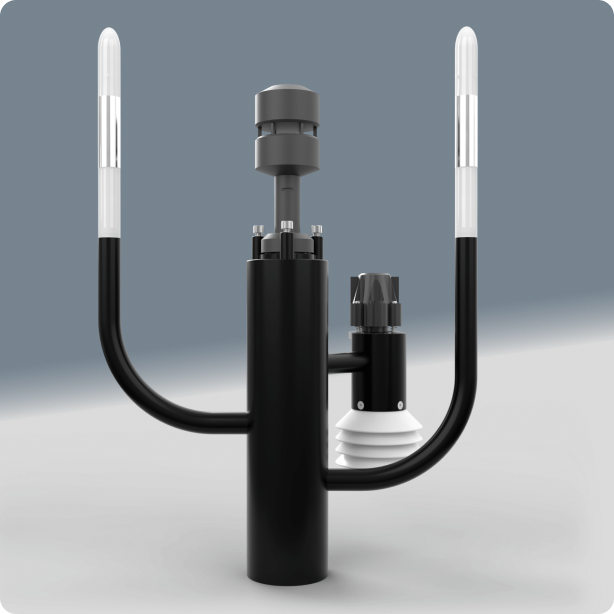
IceBrain & IC-1 gives wind farm teams clear icing visibility and decision support—so you can protect performance, manage blade heating, and plan safer work on site.
Built for wind farm operations in cold climate.
Move from reactive ice mitigation to evidence-based blade heating decisions.

Stay ahead of icing—before it impacts production.
Key features for cold-climate wind farms.
Understand and better plan for icing

Site Overview
A unified view of icing conditions, farm production, and turbine performance.

IC-1
Analyzes weather and icing conditions, including liquid water content (LWC), to provide a detailed understanding of icing intensity and how it evolves over time.

Turbine performance
Compares expected power to actual power to quickly identify icing-related losses and support operational decisions on the wind farm.

Camera
Provides visual validation of icing conditions through access to images and history.

Timelapse
Visualizes how icing events evolve over time for clear, objective analysis.
Optimize production

Heating Control
Enables blade heating to be activated or deactivated based on real conditions, helping optimize production while managing energy consumption.

Health Check
Checks the status of critical systems and flags potential failures before or during an icing event.

Power Consumption Management
Dynamically regulates turbine heating during icing events based on predefined parameters to balance de-icing needs and energy use.
Document, communicate, plan and protect

Reports
Generates daily automated reports to support internal communication and reporting needs.

Notifications
Automatically alerts teams by email or SMS in case of risk or anomalies to enable rapid response.

Forecasts
Indicates short-term icing risks to support operational planning and weather monitoring on the wind farm.

IPS Availability
Monitors the availability of heating systems to ensure they are fully operational when conditions require it.

Job Safety Analysis
Assesses ice throw risk to determine safe conditions for dispatching personnel on-site.

Start with a pilot—then scale across the wind farm.
IceBrain can be deployed on a subset of turbines first, so your team can validate the value in real operating conditions before rolling out more broadly. During the pilot, IC-1 provides on-site icing and weather measurements that help remove uncertainty and support more timely blade-heating and winter operating decisions. IceBrain then turns IC-1 and turbine data into clear visibility—alerts, reporting, and short-term icing risk forecasts—so stakeholders can review what happened and why decisions were made. If manufacturer approval or specific interfaces are required, Icetek support you through the process.
Book a demo nowFAQ
The IC-1 measures the cause of ice accretion rather than its effect. By detecting the liquid water content (LWC) in the air, it identifies atmospheric conditions that lead to icing, instead of simply measuring the resulting ice buildup. The IC-1 can also estimate ice thickness based on the measured conditions.
Liquid Water Content (LWC), measured in grams per cubic meter (g/m³), represents the amount of water droplets present in the air and serves as an indicator of icing event intensity. When the temperature is below 0 °C, these droplets can instantly freeze upon contact with surfaces such as wind turbine blades. LWC is therefore a key precursor to ice accumulation on blades.
IceBrain is designed for wind farm owners, operations teams, maintenance teams, asset management teams, and on-site technicians.
No. IceBrain can operate without an ice sensor. However, adding an IC-1 or IC-2 sensor provides a more detailed view of icing conditions and enriches the analyses available in the platform.
IceBrain does not replace SCADA—it complements it by making icing-related data easier to read, more actionable, and better aligned with day-to-day operational decision-making.
Contact
Contact us
If you’d like to learn how IceBrain + IC-1 can help maximize wind energy production in cold climates—while improving blade heating decisions and winter safety—contact our team.